|
Author: Mike Time: February 4, 2026 Introduction: I'm Mike, I've been deeply engaged in the field of wastewater treatment and environmental protection equipment for a long time, with extensive front-line experience. I focus on engineering implementation and operation optimization, sharing practical and applicable industry insights. |
If you've ever searched "submersible mixer price," you've probably seen numbers that don't make sense together-anything from "a few hundred dollars" to "tens of thousands." Both can be "true," because a submersible mixer quote can mean very different scopes of supply.
This guide gives you:
-
Realistic price ranges by tier (with clear assumptions)
-
The 12 biggest factors that move the price up or down
-
A quick way to estimate the total cost of ownership (TCO)
-
A copy-paste RFQ checklist so you can get an accurate quote fast
The 30-second answer: typical price ranges (and why they vary)
Most price confusion comes from scope. Some quotes are for the mixer only, while others include guide rails, lifting gear, sensors, control panel, VFD, cables, testing documents, spare parts, and even commissioning.
Here's a practical way to think about price by tier:
Best for: light-duty mixing, non-critical tanks, short daily runtime
Typical scope: mixer only, basic seal/standard accessories, minimal sensors
Typical range: USD 300–2,000 (often small power / simple configuration)
Tier B - Engineering / Wastewater standard configuration
Best for: municipal/industrial wastewater, continuous duty, more reliable sealing & protection
Typical scope: mixer + stronger sealing/bearings + optional sensors, can include installation parts
Typical range: USD 2,000–10,000+ (depends heavily on thrust/efficiency and scope)
What's included in the price? (The 4-part quote breakdown)
To compare offers fairly, ask every supplier to split pricing into four parts:
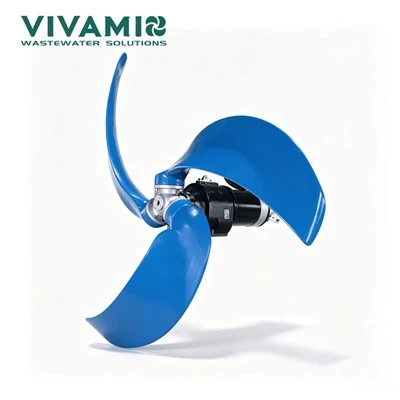
1. Mixer unit (wet end + motor)
Motor, propeller/impeller, seals, bearings, oil chamber, cable
2. Installation system
Guide rail or bracket, base, fasteners, lifting chain/hoist point, mounting hardware
3. Electrical & protection
Starter (DOL / star-delta / soft starter), protection relay, sensor interfaces
Optional: VFD, local control panel, PLC/DCS signal integration
4. Delivery & service
Export packaging, manuals, drawings, test reports, spare parts kit, warranty, training/commissioning
Most commonly "forgotten" cost items (Top 6)
- Guide rail / mounting bracket
- Lifting chain/hoist accessories
- Control panel
- VFD (and wiring/EMC components)
- Sensor package (leak, temperature, vibration)
- Cable length beyond standard (10 m vs 20–30 m can change cost)


The 12 factors that drive submersible mixer price (ranked by impact)
Below are the most important variables that create the big price differences you see online.
1. Mixing goal: blend vs. flow vs. solids suspension
A mixer sized to "keep solids suspended" will be very different from one sized for "simple blending."
Practical tip: tell suppliers your goal in plain language:
- "Prevent settling in the whole tank."
- "Homogenize influent"
- "Maintain bottom velocity (if you have a target)"
2. Thrust requirement (and efficiency: thrust per kW)
Two mixers with the same kW can have very different thrust and hydraulic performance.
Tip: Ask for performance curves or proof of thrust/efficiency at your operating point.
3. Direct-drive vs. gear-reduced low-speed mixers
- Direct-drive: often lower initial cost
- Low-speed/gear: often higher initial cost, but may reduce energy cost and improve process stability
Tip: If the mixer runs 12–24 hours/day, efficiency and reliability matter far more than the purchase price.
4. Seal system and oil chamber design
Seal quality is a major cost driver because it determines service interval and downtime risk.
Tip: For wastewater, request a clear statement of:
- Single vs. dual mechanical seal
- Oil chamber design
- Leak detection option
5. Bearings and shaft robustness
Cheap mixers may have lower bearing quality or shorter design life.
Tip: Ask for bearing type, expected design life, and maintenance recommendations.
6. Materials and corrosion protection
Typical options:
- Cast iron with coating
-
Stainless (304 / 316L) for corrosion resistance
-
Higher-grade materials for aggressive industrial wastewater
Tip: If you have high chloride or salty wastewater, specify it-material selection can change price significantly.
7. Anti-ragging / anti-clogging propeller design
Fibers, hair, and rags can cause wrapping and overload.
Tip: If you have "raggy" wastewater, it's worth paying for anti-ragging features.
8. Sensor package and motor protection
Common options:
- Thermal protection (motor)
- Leak sensor (seal failure early warning)
- Vibration monitoring (premium)
Tip: Sensors can look like "extras," but they often prevent catastrophic failures.
9. Control method: DOL vs star-delta vs soft starter vs VFD
A VFD can improve process control, but it adds cost (panel, components, tuning).
Tip: Only specify VFD if you truly need speed control or soft starting requirements.
10. Installation depth and mounting method
Deep tanks and heavy mixers require stronger rails/brackets and safer lifting arrangements.
11. Certification and compliance needs
CE/UL or hazardous-area requirements (where applicable) can significantly increase cost.
12. Commercial terms and services
EXW vs FOB vs CIF vs DDP, plus warranty scope and commissioning support.


A simple TCO model: why "cheaper" can cost more
For mixers that run many hours, energy and downtime can outweigh the purchase price.
Quick energy cost calculator
Annual energy cost = kW × hours/day × electricity rate × 365
Example:
Mixer power: 7.5 kW
Runtime: 20 h/day
Electricity: $0.12/kWh
Annual energy cost = 7.5 × 20 × 0.12 × 365
= 7.5 × 20 = 150 kWh/day
150 × 0.12 = $18/day
$18 × 365 = $6,570/year
If a higher-efficiency mixer saves even 15%, you save about:
$6,570 × 15% ≈ $985/year
Over 3 years: $2,955
Practical tip: For continuous-duty applications, ask suppliers to provide:
Estimated power draw at your operating point
Expected maintenance interval (seal/oil)
Spare parts cost and availability
How to compare quotes fairly (a buyer's checklist)
When you receive multiple offers, compare them on the same fields:
Thrust (N) and thrust/kW efficiency
Propeller diameter and speed
Seal configuration and leak detection
Material (housing/propeller/fasteners/rails)
Sensor package included
Cable length included (and cost per extra meter)
Installation system included (rails/brackets/base)
Control panel included (starter type, protection relay)
Optional VFD scope and brand (if requested)
Warranty terms and spare parts kit scope
Delivery time and Incoterms (EXW/FOB/CIF/DDP)
Documents provided (manuals, drawings, test reports)
Practical tip: If a quote is much cheaper, it is usually missing scope. Ask:
RFQ: the 10 inputs you need for an accurate quote (copy/paste)
You can copy this into an email or WhatsApp message:
- Tank dimensions (L×W×H) and operating water depth
- Liquid level range (min/max)
- Wastewater type (municipal/industrial) and source
- Solids concentration (%TS or g/L), and any viscosity info
- Temperature and pH (and chloride/salinity if relevant)
- Fibers/hair/rags/sand presence (anti-ragging needed?)
- Mixing goal (prevent settling/homogenize / flow pattern / bottom velocity target)
- Installation type (guide rails or bracket), installation depth, and lifting preference
- Power supply (Voltage / Hz / phase), and whether VFD is required
10. Scope needed (mixer only / with rails / with control panel/sensors / spare parts) + delivery term (EXW/FOB/CIF) + destination
Practical tip: If you can't provide all data, request a budgetary quote first, then confirm details for a firm quote.
FAQ (the most common buyer questions)
Q1: Why do prices differ 2–5× for the same kW?
Because kW alone doesn't define performance. Thrust, efficiency, seal system, materials, sensors, and included installation/control scope can change cost drastically.
Q2: Does the price include guide rails and control panel?
Sometimes yes, often no. Always ask suppliers to separate the quote into "mixer / installation / electrical / delivery."
Q3: Should I choose direct-drive or low-speed gear-reduced?
If you run many hours and need high efficiency, stable mixing, and long service intervals, premium configurations can pay back through lower energy and fewer failures.
Q4: Can you quote from tank volume only?
Volume helps, but accurate selection often needs geometry, solids, and mixing goal. Without key inputs, expect a wide budget range (often ±30% or more).
Final takeaway
A submersible mixer isn't a commodity item-it's a system decision. The best price is the one that delivers the required mixing performance reliably, with a clear scope and a predictable operating cost.
Need a Reliable Submersible Mixer?
Ready to find the perfect submersible mixer for your project? Get accurate quotes fast by using our easy 10-point RFQ checklist! Discover the key factors that drive pricing, compare different configurations, and calculate your total cost of ownership.