|
Author: Mike
|
Introduction
In aerobic treatment systems, the main function of the aerator is to supply oxygen to the water, allowing the oxygen in the air to effectively dissolve into the unsaturated liquid, thereby maintaining microbial growth and the bio-oxidation process.
Based on my years of experience in field installation and commissioning, this article describes different configuration schemes for tubular aerators used in aerobic tanks.
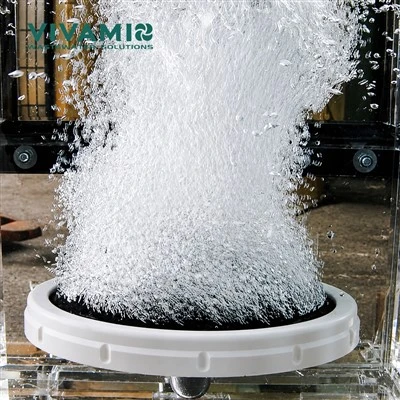
Disc Diffusers
Disc diffusers-also known as membrane diffusers, aeration heads, or Disc Diffusers-are mushroom-shaped devices. Fine-bubble diffusers are available in many forms, but in wastewater treatment the most commonly used types are tubular diffusers and disc diffusers. There is no fundamental difference between the two, as both provide high oxygen transfer efficiency and relatively low energy consumption.
The membranes used in fine-bubble diffusers are typically manufactured with nano-engineered anti-fouling surface layers, which effectively reduce clogging caused by solids or biological scaling.
Generally speaking, when the design water depth is about 6.5 m and the effective water depth is below 6 m, fine-bubble diffusers are the most suitable option.
Because fine-bubble diffusers must operate together with blowers, proper matching between the diffuser system and the air supply equipment is an important consideration during selection.


Tube Diffusers
Tube Diffusers, liftable tubular diffusers, and retractable aeration tubes all belong to the tubular diffuser category.
Rubber-membrane diffusers consist of a perforated rubber membrane mounted on a supporting tube or frame. During operation, the membrane pores automatically adjust in size according to the air pressure. If the blower suddenly stops, the perforations close immediately, preventing wastewater from entering and damaging the diffuser. In this sense, the structure functions somewhat like a pressure-relief valve in a blower aeration system, effectively protecting the diffuser from sudden pressure surges.
However, the pore diameter of the membrane directly affects oxygen utilization efficiency:
pores that are too large result in lower oxygen transfer efficiency, while pores that are too small increase system resistance even though oxygen utilization is higher. Therefore, an appropriate pore size must be selected.
Another concern is membrane aging. The air supplied by blowers is typically hot and under high pressure, which can accelerate rubber degradation over time. For this reason, membranes made from high-strength, aging-resistant elastomers should be selected to prevent tearing and diffuser failure-though this inevitably increases the purchase cost of rubber-membrane diffusers.


Conclusion
In summary, both diffuser types have their own characteristics, and each can be configured in either tubular or disc forms. In practical engineering applications, the choice of aeration device should be made after careful comparison based on actual site conditions and operating requirements.
Still unsure which aeration system is right for your aerobic tank?
Different operating conditions, tank geometries, water depths, and loading rates place very different demands on aeration equipment. Choosing the right diffuser type can significantly improve oxygen transfer efficiency while reducing energy consumption and long-term operating costs.
With extensive experience in wastewater treatment project design, installation, and commissioning, we provide customized aeration solutions-from disc diffusers and tube diffusers to complete blower-diffuser systems-supported by one-stop technical service to ensure stable and efficient long-term operation.
Need a Reliable Submersible Mixer?
Get expert advice, customized solutions, and competitive pricing for your wastewater treatment project.