|
|
Author: Mike Wastewater Treatment Engineer Water Treatment Expert Time: May 14, 2026 Introduction: I'm Mike. I've been deeply engaged in the field of wastewater treatment and environmental protection equipment for a long time, with extensive front-line experience. I focus on engineering implementation and operation optimization, sharing practical and applicable industry insights. |

Preface
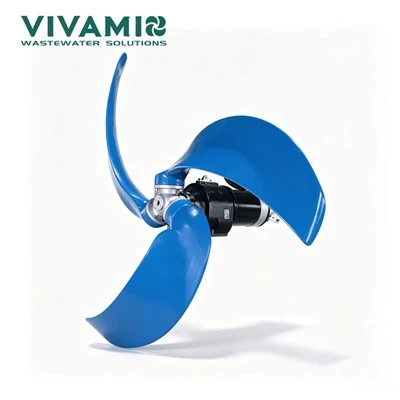
High-speed submersible mixers are mainly applied in regulating tanks, coagulation reaction tanks and anaerobic tanks for sewage treatment, serving for chemical dosing mixing, sediment prevention as well as rapid homogeneous mixing of sewage and sludge. With high rotating speed and strong shearing force, power selection directly determines mixing effect, motor service life and operation energy consumption.
1.Core Selection Criterion: Power Density per Unit Volume
◎ Clean Water / Low-Concentration Wastewater: 8–10 W/m³
◎ Wastewater containing sludge and readily settleable impurities: 12–15 W/m³
◎Total required power (kW) = Effective tank volume (m³) × Unit power/1000
After calculating the theoretical power, simply round up to match the national standard motor power.
2.Standard Power Corresponding to Typical Pool Capacity (Industry-Standard Empirical Values)
For tank volumes < 50 m³, select a 0.85 kW high-speed submersible mixer.
50–100 m³ 1.5 kW.
100–200 m³ 2.2 kW.
200–400 m³ 3.0 kW.
400–800 m³ 4.0 kW.
800–1200 m³ 5.5 kW.
3.Power Increase Principles for Special Operating Conditions
◎When sludge concentration is high or there is a large amount of sand and impurities, increase the power by 20%–30%.
◎For elongated tanks or those with many dead zones, prioritize increasing the number of units rather than blindly increasing the power of individual mixers.
◎When the water depth is shallow (<2.5 m), avoid selecting excessively high power to prevent surface surging and vortex formation.
◎For long-term continuous operation in harsh wastewater environments, uniformly increase the power by one grade to prevent motor overload and burnout.
◎For long-term continuous operation in harsh wastewater environments, uniformly increase the power by one grade to prevent motor overload and burnout.

4.Key Considerations for Model Selection
◎High-speed mixers have relatively low torque and are not suitable for water bodies with highly viscous slurry or large amounts of fibrous debris.
◎Insufficient power will result in uneven mixing and sludge sedimentation
◎Excessive power causes energy waste, strong vibration and shortened service life of equipment.
Here's the English translation of that sentence:
5.Summarize:
The operating parameters of submersible mixers vary significantly. To ensure equipment service life and operational performance, it is recommended that professional engineers perform precise calculations and selection based on tank dimensions, water quality, water depth, and other data, so as to avoid unstable operation and excessive energy consumption later on.
Need a Reliable Submersible Mixer?
Get expert advice, customized solutions, and competitive pricing for your wastewater treatment project.