|
|
Author: Mike Wastewater Treatment Engineer Water Treatment Expert Time: January Jun 20, 2025 Introduction: I'm Mike, I've been deeply engaged in the field of wastewater treatment and environmental protection equipment for a long time, with extensive front-line experience. I focus on engineering implementation and operation optimization, sharing practical and applicable industry insights. |

As we all know, in the process of sewage treatment, due to the needs of the process, the mixture of sewage and sludge must circulate in the tank at a certain flow rate.
If the flow rate is too low, not only will the sewage treatment be unable to proceed continuously, but the sludge in the mixed liquid will flocculate and precipitate, causing a large amount of sludge to accumulate at the bottom of the tank, greatly reducing the effective volume of the tank, reducing the treatment effect, and affecting the effluent water quality.
At this time, you need to use a submersible mixer.
Through the stirring and pushing of the submersible mixer, the mixed liquid can maintain a certain flow rate, which can effectively prevent the sludge from depositing at the bottom of the tank, which can be said to be very convenient.
However, when most users choose a submersible mixer, they often only consider whether it can meet the working conditions, and rarely consider other factors such as the efficiency and operability of the equipment, resulting in a waste of resources.
Today, the VIVAMIX engineering team will talk to you about the selection, detection, maintenance and other issues of submersible mixers. I hope that water friends can choose equipment that is truly suitable for the working conditions and is efficient, energy-saving, has few operating failures, and is easy to maintain.
1. Selection of submersible mixers
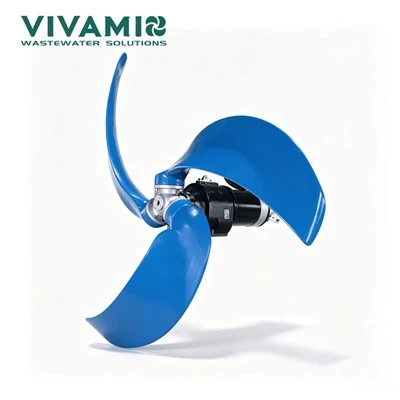
Submersible mixers are submersible equipment that works continuously under full immersion conditions and integrates stirring, mixing and flow-pushing functions. They are suitable for various tanks, such as oxidation ditches, anaerobic acidification tanks, homogenization tanks, etc. They are composed of underwater motors, reducers, stirring paddles and control systems.
Among them, the motor has overload, water leakage and overheating protection functions. The stirring paddle is generally designed in a special spiral shape, which can generate greater thrust. The high-speed mixer has short blades and the low-speed mixer has long blades.
When the equipment is working, the propeller is driven by the underwater motor and reducer to rotate, generating a higher flow-pushing effect to push the water forward, improve the water flow conditions in the tank, obtain the flow rate required by the process, and effectively promote the uniformity of the mixed liquid water quality and prevent sludge deposition, thereby improving the efficiency of sewage treatment.
The types of submersible mixers used more in sewage treatment plants are divided into two series: mixing and stirring and low-speed flow-pushing.
The mixing and stirring series is suitable for stirring liquids containing suspended matter in the process of municipal and industrial sewage treatment. Generally, multi-stage electrodes are used, and the direct-connected structure is adopted, with low energy consumption and high efficiency. The impeller of the mixing and stirring machine is formed by precision casting or stamping, with high precision, large thrust and compact structure.
The low-speed push-flow series mixer is suitable for aeration tanks and anaerobic tanks in municipal and industrial sewage treatment plants, and is used for the effective flow and aeration of water in the sewage pool during water circulation and nitrification, denitrification and dephosphorization stages. The low-speed mixer adopts a cycloidal pinwheel reducer, equipped with a motor with low power and low speed. The impeller of the mixer has a large diameter and is cast from polyurethane material and aluminum alloy, with high strength and strong corrosion resistance.
The correct selection of the submersible mixer directly affects the normal use of the mixing equipment. As the main principle of selection, it is necessary to allow the mixer to fully exert its stirring function in a suitable sewage pool. This standard can generally be determined by the flow rate.
In order to prevent the active sludge in the sewage pool from settling at the bottom of the pool and avoid the formation of a "dead zone", the mixed liquid in the sewage pool must be maintained at a flow rate of 0.3m/s. According to the different process requirements of the sewage treatment plant, the optimal flow rate for the selection of submersible mixers should be guaranteed to be between 0.15 and 0.3m/s. If the flow rate is lower than 0.15m/s, the plug flow mixing effect cannot be achieved. If the flow rate exceeds 0.3m/s, it will affect the process effect and cause waste.
Therefore, before selecting, first determine where the submersible mixer is used, such as a sewage pool, sludge pool or biochemical pool; secondly, the medium parameters, such as suspended matter content, temperature, pH value, etc.; the shape of the pool, water depth and even installation method will affect the selection, and energy saving factors should also be considered, because this will affect the future operating costs.
2. Inspection of submersible mixers
Based on the size and shape of the sewage treatment tank, refer to the parameter table of VIVAMIX to draw the power-hydraulic performance diagram of the hydraulic performance requirements of the submersible mixer to make a reasonable judgment and select the motor power of the submersible mixer suitable for the working conditions. The required supporting power of the mixer is determined by the volume, the density of the stirred liquid and the stirring depth. One or more mixers are used according to the specific situation. If you need help selecting the model, please contact our VIVAMIX technical team
After determining the motor power that meets the working conditions, there will be many models of products to choose from. The prices of submersible mixers sold on the market now vary greatly, so the purchase cost, operating cost and maintenance cost should be considered comprehensively within the price budget. If you need to obtain the price of the submersible mixer, please contact our VIVAMIX technical team.
Need a Reliable Submersible Mixer?
Get expert advice, customized solutions, and competitive pricing for your wastewater treatment project.