|
|
Author: Mike Wastewater Treatment Engineer Water Treatment Expert Time: July 28, 2026 Introduction: I'm Mike. I've been deeply engaged in the field of wastewater treatment and environmental protection equipment for a long time, with extensive front-line experience. I focus on engineering implementation and operation optimization, sharing practical and applicable industry insights. |

Focus Keywords
submersible mixed liquor recirculation pump
submersible recirculation pump
internal recirculation pump
low head high flow pump
wastewater treatment pumpa
How to Select a Submersible Mixed Liquor Recirculation Pump for Wastewater Treatment
This guide explains the main factors that should be reviewed before ordering a submersible recirculation pump.
What Is a Submersible Mixed Liquor Recirculation Pump?
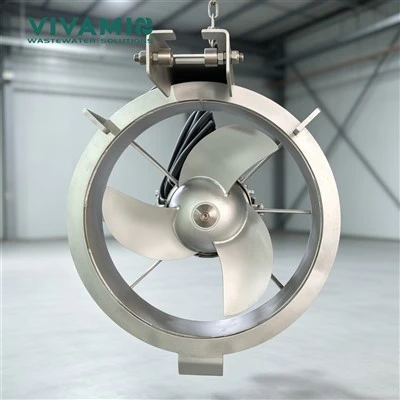
A submersible mixed liquor recirculation pump transfers nitrate-rich mixed liquor from one biological treatment zone to another.
In A/O and A²/O systems, the pump normally returns mixed liquor from the aerobic tank to the anoxic tank. In the anoxic zone, denitrifying bacteria convert nitrate nitrogen into nitrogen gas, supporting total nitrogen removal.
Unlike a conventional high-head centrifugal pump, this type of pump is designed for:
- Low hydraulic head
- Large recirculation flow
-
Continuous underwater operation
-
Short internal transfer distances
-
Through-wall pipe or recirculation channel installation
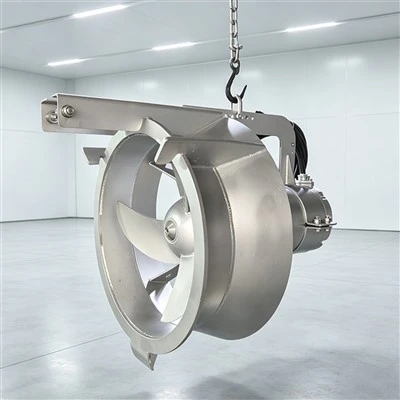
Its propeller-type hydraulic structure moves a large volume of mixed liquor without generating unnecessary discharge pressure.
Start with the Required Recirculation Flow
Mixed liquor recirculation normally involves a small difference in water level, but the total head is not always equal to the static level difference.
The calculation should also consider:
- Through-wall pipe resistance
- Pipe length and diameter
- Bends and fittings
- Valves or flap gates
-
Outlet losses
-
Channel restrictions
-
Screens or protective structures
-
Changes in operating water level
A pump designed for low-head, high-flow service should operate close to its intended hydraulic range.
The standard VIVAMIX VM-W series covers approximate head ranges from 0.25 to 2.00 metres, depending on the selected model and motor power.
Using a high-head sewage pump for this duty can result in unnecessary energy consumption and unstable flow control.
Confirm the Wastewater Treatment Process
The biological process affects the required operating conditions.
A/O and A²/O Systems
In A/O and A²/O plants, the pump transfers nitrified mixed liquor from the aerobic zone back to the anoxic zone.
Selection should consider:
- Required internal recirculation ratio
- Aerobic and anoxic tank water levels
- Nitrate loading
- Available carbon source
- Variation in influent flow
MBR Wastewater Treatment Plants
MBR plants often have higher mixed liquor suspended solids concentrations than conventional activated sludge systems.
The pump should be selected with attention to:
- Mixed liquor concentration
- Liquid viscosity
- Variable influent loading
- Membrane tank arrangement
- Required VFD operating range
MBBR Systems
In MBBR plants, care should be taken to prevent suspended biofilm carriers from entering the pump or recirculation pipe.
The system may require:
- Carrier-retention screens
- Protective grilles
- Appropriate flow velocity
- Controlled turbulence near the pump inlet
Oxidation Ditches
In oxidation ditch systems, the pump may be used for process circulation or transfer between zones where the static head is limited.
The operating point should be coordinated with existing mixers, surface aerators or flow-control structures.
Review Tank and Installation Dimensions
A technically suitable pump may still create installation problems if the tank geometry is not reviewed in advance.
Important dimensions include:
- Tank length and width
- Operating water depth
- Maximum and minimum water level
- Wall thickness
- Through-wall pipe diameter
- Distance from the pump to the tank floor
- Available lifting height
- Guide-rail position
- Access platform dimensions
The pump must have enough surrounding space to develop stable inlet flow. Poor inlet conditions can increase vibration, reduce hydraulic efficiency and create uneven loading on the propeller.
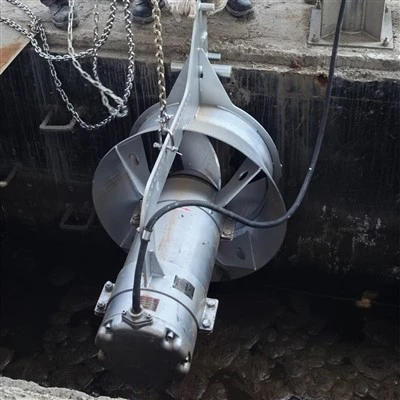
VIVAMIX recirculation pumps can be supplied with guide-rail or wall-mounted installation systems.
Guide-Rail or Wall-Mounted Installation?
Guide-Rail Installation
A guide-rail system allows the pump to be lowered into position and lifted for inspection without draining the tank.
This arrangement is suitable when:
Regular maintenance access is required
The tank has a vertical wall
A lifting device is available
The pump connects to a fixed through-wall pipe
Wall-Mounted Installation
A wall-mounted system can provide a compact solution for projects with limited space or an existing return opening.
The mounting bracket and guide structure should be customized according to the civil dimensions.
Select the Correct Construction Material
SS304 stainless steel is suitable for many municipal wastewater applications. However, industrial wastewater may contain chlorides, aggressive chemicals or other corrosive substances.
| The material selection should consider: | Possible material configurations include: |
| Chloride concentration | SS304 stainless steel |
| pH value | SS316 stainless steel |
| Wastewater temperature | Customized wetted components |
| Chemical composition | Project-specific elastomers |
| Abrasive solids | Alternative seal materials |
| Required service life |
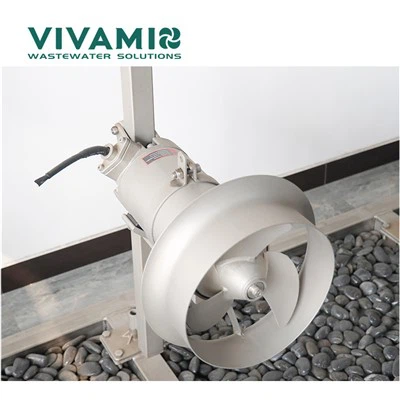
The standard VIVAMIX configuration includes an SS304 propeller and motor housing, SS420 motor shaft, nitrile rubber sealing ring and silicon carbide mechanical seals.
Check the Motor and Electrical Supply
The motor must match the electrical standard of the installation country.
Information required for production includes:
- Voltage
- Frequency
- Number of phases
- Starting method
- Cable length
- Control-panel requirements
- Local electrical standard
Common project configurations may include 380 V/50 Hz, 400 V/50 Hz, 415 V/50 Hz or 460 V/60 Hz.
The standard motor protection level should be suitable for continuous submersible operation. VIVAMIX pumps use IP68 submersible motors with Class F insulation.
Information to Send to the Pump Manufacturer
For an accurate selection, prepare the following information:
- Required recirculation flow
- Total dynamic head
- Wastewater treatment process
- Wastewater type and composition
- Tank dimensions
- Operating water depth
- Through-wall pipe diameter
- Installation method
- Voltage and frequency
10.Required control method
11.Destination country
Providing complete information reduces the risk of receiving a pump that is oversized, undersized or incompatible with the installation structure.
Common Selection Mistakes
Selecting Only by Motor Power
Two pumps with the same motor power may have very different flow and head performance.
Ignoring Pipeline Resistance
Even a short through-wall pipe can create additional hydraulic losses.
Using a High-Head Sewage Pump
A conventional sewage pump may consume more energy than necessary in an internal recirculation application.
Failing to Check Installation Space
The pump, guide rails, lifting system and pipe connection must all fit the actual tank dimensions.
Ignoring Wastewater Composition
Industrial wastewater may require upgraded materials or sealing components.
Conclusion
A reliable Submersible Mixed Liquor Recirculation Pump should be selected according to the required flow, total dynamic head, treatment process, tank structure, wastewater characteristics and electrical conditions.
For most internal recirculation duties, the best solution is not the pump with the largest motor. It is the pump that provides the required flow efficiently at the actual operating head.
VIVAMIX provides project-based pump selection, installation drawings, customized materials, voltage options, guide-rail systems, VFD controls and intelligent monitoring solutions for municipal and industrial wastewater treatment projects.
Request a Pump Selection
Send us your required flow, head, process type, tank dimensions, voltage and installation conditions. Our engineering team will recommend a suitable model and provide the performance curve, installation drawing and factory quotation.