|
|
Author: Mike Wastewater Treatment Engineer Water Treatment Expert Time: Aug 07, 2025 Introduction: I'm Mike, I've been deeply engaged in the field of wastewater treatment and environmental protection equipment for a long time, with extensive front-line experience. I focus on engineering implementation and operation optimization, sharing practical and applicable industry insights. |

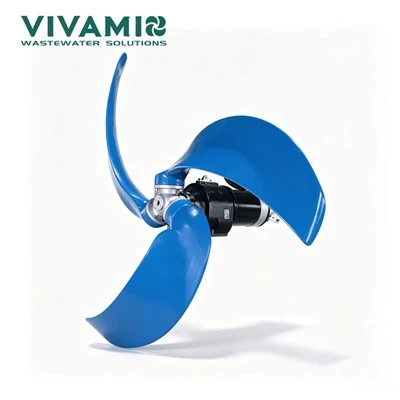
The primary function of a submersible mixer is to promote the circulation of wastewater within the tank, ensuring effective mixing and preventing sedimentation. Therefore, selecting the right submersible mixer has a direct impact on the overall efficiency of wastewater treatment. the VIVAMIX technical team will walk you through several key steps to help you understand how to choose the most suitable submersible mixer and what important factors need to be considered.
Summary Guide to Submersible Mixer Selection
Define the Application Scenario:
Submersible mixers are commonly used in wastewater treatment in tanks such as equalization tanks, anaerobic tanks, anoxic tanks, and aerobic tanks. Their purpose is to prevent sedimentation, promote reactions, or achieve uniform mixing.
Power Calculation Method:
The required power is mainly estimated by multiplying the tank volume by the specific power coefficient. The reference value generally ranges from 2 to 6 W/m³, depending on the type of medium and process requirements.
Medium Factors Must Be Considered:
These include density, viscosity, solid content, pH value, temperature, and corrosiveness. They determine the mixer's material, protection level, and operating load.
Key Factors in Choosing the Mixing Method:
Common types include horizontal circulation, inclined propulsion, vertical circulation, and multi-point coordinated mixing. The choice should be based on the tank structure, water depth, and mixing purpose.
Core Factors Affecting Selection:
Medium characteristics (whether it tends to settle, presence of impurities)
Tank size and shape (length, width, depth)
Process requirements (reaction, mixing, anti-clogging)
Installation conditions (presence of guide rails, ease of maintenance
VIVAMIX
If you are unsure about the specific model or mixing method, it is recommended to provide basic parameters (tank dimensions, medium characteristics, and process objectives) so that the VIVAMIX technical team can offer professional recommendations.

Identify the Application Scenarios for the Submersible Mixer
Start from the Wastewater Treatment Process to Define Technical Requirements
Submersible mixers are typically used in tanks where water circulation, mixing, sediment prevention, or enhanced reaction efficiency is required. The main application areas include:
Equalization Tank: Prevents the settling of suspended solids and ensures uniform influent distribution.
Anaerobic Tank: Promotes thorough mixing of sludge and wastewater to support fermentation processes.
Anoxic Tank: Provides continuous mixing necessary for the denitrification process.
Aerobic Tank: Enhances water movement to improve aeration uniformity and increase oxygen transfer efficiency.
Chemical Reaction Tank: After dosing chemicals, the mixer helps improve fluid circulation, thereby enhancing reaction efficiency.
Summary:Any tank that requires mixing, sedimentation prevention, avoidance of stratification, or improved mass transfer efficiency can benefit from the use of a submersible mixer.
Calculating the Required Power of the Submersible Mixer
The selection of a submersible mixer is typically based on the tank volume, combined with the required mixing power per cubic meter.
Formula:
Required Power (P) = Tank Volume (V) × Specific Power per Unit Volume (P₀)
Notes:
P: Total power of the mixer (in watts, W)
V: Volume of the tank (in cubic meters, m³)
P₀: Reference power per unit volume, which varies depending on the purpose and type of tank (in W/m³)
Different types of tanks have different reference power values.
We can estimate the required power based on the type of tank, using the following reference ranges:
|
Application Scenario |
Main Function |
Recommended Power Value P₀ (W/m³) |
|
Equalization Tank |
Uniform mixing, prevent sedimentation |
3~5 |
|
Anaerobic Tank |
Enhance biological reaction |
4~6 |
|
Anoxic Tank |
Mixing for denitrification |
3~5 |
|
Aerobic Tank |
Mixing to support aeration |
2~4 |
|
Chemical Reaction Tank |
Rapid mixing of dosing chemicals |
5~10 |
|
High-Concentration Wastewater Tank |
Prevent solid deposition |
6~8 |
Take VIVAMIX VM-submersible mixer calculation as an example:
For an anaerobic tank measuring 10 m × 8 m × 4 m, the volume is:
V=10×8×4=320m3
Assuming a mid-range power value of 5 W/m³ for calculation:
P=320×5=1600W
This means a mixer with approximately 1.6 kW power is required. Considering a safety margin, it is usually more appropriate to select a 2.2 kW Submersible mixer model.
If you are more focused on the mixing effect, you can use flow velocity as a reference:
Some designers prefer to judge whether the mixer meets requirements based on water flow velocity. Generally, a water velocity of 0.15 to 0.3 meters per second can satisfy most mixing needs.
Some manufacturers also recommend models based on thrust (measured in newtons, N), which is often closer to the actual performance.
For assistance with selecting the right model, please contact the VIVAMIX technical team.:https://www.vivamixer.com/contact-us

How To Cooperate With Us?
Contact us today to get customized solutions and quotes for VIVAMIX wastewater mixing systems, and make your wastewater treatment system more efficient and energy-saving!
Take into account the properties of the mixing medium
When selecting and using a submersible mixer, the properties of the medium are one of the most critical factors to consider. Different media-such as clean water, wastewater, slurry, or chemical liquids-directly affect the mixer's design, material selection, thrust requirements, power demand, and service life.
Below are the key medium factors and parameters we should focus on when selecting a submersible mixer. I have organized them by category for easy and clear understanding:
Physical Properties of the Medium (Basic Parameters)
Medium Type: Clear water, domestic sewage, industrial wastewater, oily water, sandy water, chemical liquids, etc. Different types affect the mixing difficulty and material selection of the mixer.
Density (kg/m³): The density of wastewater typically ranges from 1000 to 1050 kg/m³. The higher the density, the greater the thrust required for mixing.
Viscosity (Pa·s): High-viscosity fluids such as concentrated sludge or oily liquids are more difficult to mix. The higher the viscosity, the greater the power required.
Solid Content (%): The amount of suspended solids, particles, and sludge. Higher solid content requires anti-clogging and anti-wrapping design features.
Temperature (°C): Operating temperature of the medium. If it exceeds 40°C, a high-temperature motor or special sealing is required.
Chemical Properties (Key Factor for Material Selection):
Oxidizing Properties: Strong oxidizers such as sodium hypochlorite and hydrogen peroxide require higher-quality materials for seals, bearings, and impellers.
pH Range: If the wastewater pH is below 5 or above 9, neutral materials are not corrosion-resistant, and chemical-grade equipment must be selected.
Hydraulic Operating Conditions (Determining Thrust and Impeller Design)
Tank Dimensions (Length × Width × Depth): Affect the mixing coverage and the number of mixers needed. For tanks deeper than 4 meters, long-shaft or large-impeller mixers should be selected.
Required Flow Velocity (m/s): Generally between 0.15 and 0.3 m/s, used to estimate the mixer's thrust and power.
Presence of Dead Zones: If present, multiple mixers need to be arranged to ensure there are no blind spots in the entire tank.
Other Practical Conditions:
Check for the presence of fibrous debris; if present, consider using anti-wrapping impellers.
Check whether the operating environment is chemical; if so, it is recommended to choose explosion-proof motors.
Summary: How Do Medium Factors Affect Selection?
Density, viscosity, and solid content affect the required thrust and power.
Corrosiveness and pH value influence material selection.
Characteristics of impurities impact impeller choice and motor protection level.
Hydraulic conditions determine the number of mixers, their arrangement, and flow velocity
requirements.https://www.vivamixer.com/contact-us
VIVAMIX
How To Cooperate With Us?
Contact us today to get customized solutions and quotes for VIVAMIX wastewater mixing systems, and make your wastewater treatment system more efficient and energy-saving!

Choosing the Appropriate Mixing Method for a Submersible Mixer
Overview of Common Mixing Methods
Horizontal Circulation Mixing:
The impeller is parallel to the tank bottom, creating a horizontal circular flow. Suitable for equalization tanks, anaerobic tanks, and anoxic tanks.
Inclined Propulsion Mixing:
The mixer is installed at an angle to drive large-scale flow. Ideal for long narrow tanks, oxidation ditches, and deep water tanks.
Vertical Circulation Mixing:
The flow circulates up and down, helping to lift settled solids. Suitable for sedimentation tanks where sand or sludge buildup needs to be prevented.
Directional Flow Mixing:
Multiple mixers are arranged to create a specific flow direction. Used in process areas where flow control is required.
Multi-Point Coordinated Mixing:
Several low-power mixers work together to cover large or complex tanks with potential dead zones.
How to Choose the Mixing Method for Different Process Scenarios
Equalization Tank
Recommended: Horizontal circulation or inclined mixing
Reason: Prevents sedimentation and ensures uniform water quality
Anaerobic/Anoxic Tank
Recommended: Inclined mixing or multi-point mixing
Reason: Enhances biological reactions, prevents short-circuiting, and allows for gentle mixing
Oxidation Ditch
Recommended: Inclined propulsion mixing + flow guide
Reason: Maintains flow direction and improves dissolved oxygen distribution
Grit Chamber
Recommended: Vertical circulation or directional flow
Reason: Prevents grit accumulation and facilitates discharge
High-Concentration Sludge Tank
Recommended: Multi-point mixing or strong circulation
Reason: High solid content requires anti-clogging features and strong mixing force
Factors to Consider When Choosing a Mixing Method
Tank Shape and Size:
Rectangular tanks: Best suited for inclined propulsion mixing
Circular tanks: Ideal for circulation mixing or vertical mixing
Irregular-shaped tanks: Better to use multiple mixers working together
Pool depth: more than 4m, it is recommended to use inclined installation or deflector to improve the mixing effect of the upper and lower layers
Mixing Purpose:
Homogenization and Anti-Sedimentation: Prioritize horizontal circulation or inclined mixing
Rapid Mixing: Choose a mixing method with high impeller speed and fast flow
Biochemical Reactions: Requires slow, uniform mixing with no short-circuit flow
Practical Installation Tips (Based on Mixing Method)
For shallow water and small tanks:
Horizontal installation (0°) is recommended. It provides wide coverage and is ideal for preventing sedimentation.
For medium to deep tanks:
Inclined installation (15°–30°) is advisable. It enhances water flow penetration and improves vertical mixing.
For circular tanks or localized mixing:
Vertical installation is suitable. It creates vertical circulation but has a limited coverage area.
Need a Reliable Submersible Mixer?
Get expert advice, customized solutions, and competitive pricing for your wastewater treatment project.